How DePIN Is Building the Machine Economy
Robots are becoming autonomous economic actors. Explore how DePIN, machine identity, stablecoin payments, positioning and decentralized infrastructure could enable robots to work, pay and transact across open networks.

🤖 AI TL;DR SUMMARY
- Robots are becoming autonomous economic actors.
- Explore how DePIN, machine identity, stablecoin payments, positioning and decentralized infrastructure could enable robots to work, pay and transact across open networks.
Why Robots Need Money: How DePIN Is Building the Machine Economy
A strange question is becoming increasingly relevant:
What happens when a robot needs to pay for something?
Not an AI agent buying an API call.
A physical machine.
A delivery robot that needs electricity. A drone that needs centimetre-level positioning. A warehouse robot that needs compute. A machine that needs to rent a charging dock from another operator.
Today, these machines are almost always attached to a company. The company owns the robot, controls its software, pays its bills and settles its transactions.
That works.
But it breaks down when robots become independently owned economic actors.
That is where DePIN — Decentralized Physical Infrastructure Networks — starts becoming interesting.
The payment problem
Imagine owning a delivery robot.
It works 12 hours a day. At some point it needs to recharge. Your robot arrives at a charging station operated by another company.
The station needs to answer several questions almost immediately:
- Is this a real machine?
- Who owns it?
- Has this machine behaved reliably before?
- Can it pay?
- What happens if it damages the station?
- Can the transaction be settled automatically?
The obvious answer today is to attach a conventional payment method.
But traditional payment infrastructure was designed primarily around humans and businesses, not millions of machines making tiny autonomous transactions.
A card transaction can contain percentage-based fees plus fixed costs. The fixed component becomes particularly painful when the transaction itself is worth only cents.
A bank transfer is even less suitable for a 40-cent transaction.
The problem is not simply that blockchain is cheaper.
The deeper problem is machine autonomy.
A robot needs to be able to identify itself, authorize an action and settle a transaction without requiring a human to manually intervene every time.
But most robots don't need crypto
This distinction matters.
DePIN is not going to replace the software stack of Amazon warehouses or Tesla factories.
Amazon can operate its robots inside its own closed environment. Tesla can coordinate machines inside its factories. A restaurant can have a contractual relationship with a delivery operator.
There is no reason to put those transactions on a public network.
The interesting market appears in the gaps.
A robot owned by Company A wants to use infrastructure owned by Company B.
A drone needs positioning data from an independent provider.
A delivery robot needs a charging station it has never used before.
An AI agent wants to hire a physical robot to perform a task.
That is where an open machine economy begins to emerge.
The machine economy needs an infrastructure stack
A robot cannot simply be given a wallet and sent into the world.
It needs infrastructure around that wallet.
1. Positioning
A machine has to know where it is.
GPS is often not accurate enough for autonomous robotics. High-precision applications can require centimetre-level positioning.
Real-Time Kinematic, or RTK, positioning improves GNSS accuracy by using correction data from known reference stations.
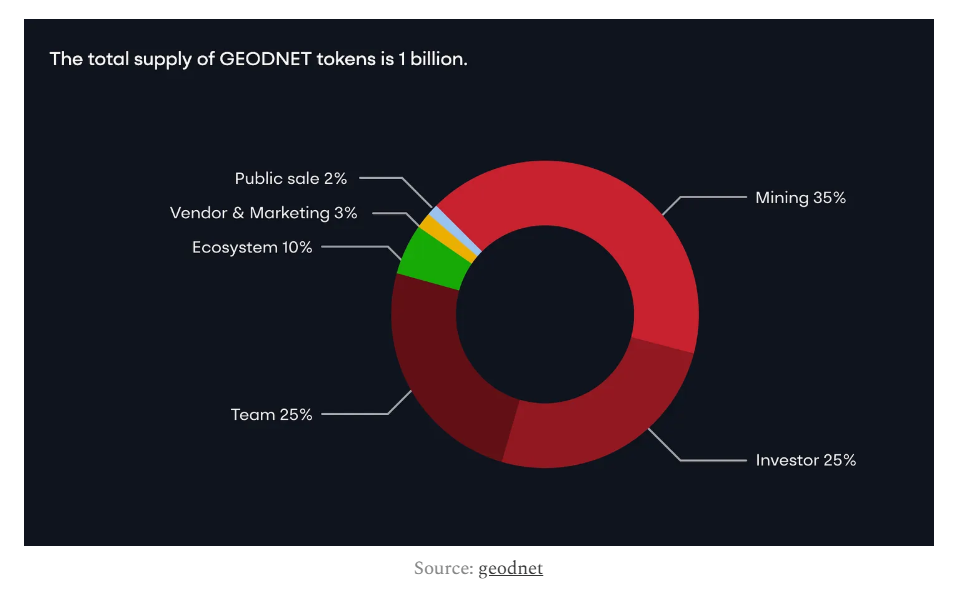
This is one of the areas where GEODNET is building DePIN infrastructure. Its model uses a distributed network of positioning stations, while token incentives help bootstrap the physical network.
The important point is not that robots need crypto to know where they are.
They don't.
They need accurate positioning.
The DePIN model is interesting because token incentives can help coordinate the deployment of physical infrastructure that would otherwise require a centralized company to build and maintain.
IoTeX has also worked on device identity and verifiable physical activity around DePIN networks. Its ioID system can associate physical devices with decentralized identities, while W3bstream is designed to verify real-world device activity.
2. A common operating system
The next problem is interoperability.
Robots from different manufacturers generally operate with different software stacks.
A Unitree robot, a delivery robot and an industrial machine may have completely different interfaces.
OpenMind is attacking this layer with OM1 and FABRIC — a hardware-agnostic robotics software and coordination stack designed to let different machines operate through a common framework.
The analogy is useful:
Android did not manufacture every smartphone. It created a common software layer that could run across different hardware.
A similar abstraction layer could eventually make robotics more interoperable.
That becomes particularly interesting when the machines also need to coordinate economic activity.
3. Machine identity
A human has a passport, company registration, bank account and credit history.
A machine needs equivalent primitives.
This is where blockchain can provide something useful.
A machine can have a cryptographic identity that allows it to sign actions as itself.
IoTeX's ioID approach is one example of this model. The identity can be tied to hardware and used to associate physical activity with an on-chain identity.
peaq is approaching the problem from another direction.
Its machine economy infrastructure includes machine identities, machine NFTs and machine reputation/credit concepts.
The idea is simple:
If machines are going to transact with strangers, they need a way to establish trust without first signing a traditional contract.
That does not mean blockchain magically creates trust.
It creates a verifiable record that other systems can use.
4. Machine credit
This becomes even more interesting when robots start earning money.
Imagine two delivery robots.
Robot A has completed 50,000 deliveries, generated revenue consistently and has never defaulted on a payment.
Robot B was created yesterday.
If both machines want to rent the same charging station, should they receive identical terms?
Probably not.
A machine economy therefore needs something similar to credit history.
peaq has developed a Machine Credit Rating concept that evaluates machines using factors such as revenue, activity and trust.
This is an important conceptual shift.
The robot is no longer simply equipment.
It becomes an economic asset with a history.
That opens the door to financing, leasing, insurance and eventually machine-backed credit.
5. Micropayments
Now we get to the part crypto is particularly suited to.
A machine may need to make hundreds or thousands of tiny payments.
Electricity.
Compute.
Maps.
Sensor data.
Navigation.
Storage.
Charging.
Human teleoperation.
Traditional financial infrastructure was not designed around this pattern.
Stablecoins provide a programmable digital settlement asset, while payment protocols such as x402 are designed to allow software and autonomous agents to pay for internet resources programmatically.
OpenMind and Circle demonstrated a robot-payment workflow using USDC and x402, showing how an autonomous machine could recognize a resource, initiate payment and complete the transaction without a human manually approving each step.
The demonstration was a test environment rather than proof of a fully deployed machine economy, but it showed an important technical primitive: a machine can control a wallet and participate in a payment flow itself.
Robots paying robots is only half the story
There is another possibility.
Instead of a robot paying another robot, an AI agent could pay a physical robot.
An AI agent has software, capital and objectives.
A robot has a body.
Combine them and you get something much more interesting.
An AI agent could hire a robot to:
- inspect a building
- deliver an object
- collect sensor data
- perform a physical repair
- photograph a location
- transport goods
- operate equipment
The AI agent supplies the demand.
The robot supplies physical execution.
The payment layer connects the two.
This is one reason the intersection of AI agents + robotics + DePIN is becoming strategically interesting.
Why this market could become large
The robotics market itself is already enormous.
According to the International Federation of Robotics, 542,000 industrial robots were installed globally in 2024, while the operational stock reached approximately 4.664 million units.
And that is before counting the much broader universe of consumer robots, drones, autonomous vehicles and emerging humanoid systems.
J.P. Morgan's July 2026 research estimates that global robotics sales could grow from roughly $100 billion in 2025 to $2.5 trillion annually by 2035 in its base case. Its analysis also cites a potential humanoid robotics market of roughly $300 billion by 2035. These are forecasts, not guaranteed outcomes, and depend heavily on advances in reliability, safety and manufacturing economics.
The important question for crypto is therefore not:
"Can blockchain make robots better?"
It can't.
The better question is:
"What happens when millions of robots operate outside the company that manufactured them?"
That is the open-counterparty problem.
DePIN is infrastructure for the gaps
This is the strongest case for DePIN robotics.
A closed robotics ecosystem can keep everything internal.
An open robotics economy cannot.
It needs:
Positioning — Where am I?
Identity — Who am I?
Coordination — How do I interact with another machine?
Payment — How do I pay?
Reputation — Should you trust me?
Credit — Can I finance myself?
Insurance — Who absorbs the risk?
Infrastructure rental — Can I buy compute, charging, maps or teleoperation when I need it?
That is much closer to a financial and infrastructure stack than a traditional robotics stack.
The biggest risk
There is an obvious reason this could fail.
The major robotics companies may simply keep everything closed.
Amazon does not need an open payment network if all its robots operate inside Amazon's infrastructure.
Tesla does not need a public machine economy if its machines remain inside Tesla's ecosystem.
Large Chinese manufacturers can pursue their own hardware, software and service platforms.
In that world, DePIN remains a niche infrastructure layer.
That is why the thesis should not be:
"Every robot will use crypto."
The more defensible thesis is:
"Open robotic markets may need neutral infrastructure."
If machines from different companies start meeting, working together and buying services from one another, someone needs to provide the neutral rails.
From robots to machine finance
The really interesting part comes after payments.
Once a robot has:
- an identity
- measurable activity
- revenue
- a reputation
- transaction history
it starts looking less like a dumb machine and more like an economic asset.
Then entirely new financial products become possible.
Who finances a robot?
Who insures it?
Can a fleet be used as collateral?
Can investors finance machines based on expected cash flow?
Can a warehouse post a job and let multiple robots bid for it?
Can an AI agent rent a robot for ten minutes and pay only for the completed task?
These questions lead from machine identity → machine payments → machine credit → machine finance.
That is where tokenization becomes more interesting.
Not because putting a token on a robot is inherently valuable.
Because the token may eventually represent an asset that actually produces economic activity.
The machine economy is still tiny
This is important to keep in perspective.
Robotics is a huge industry.
The crypto robotics sector is not.
The opportunity is still experimental and concentrated among a relatively small number of infrastructure projects.
The infrastructure is also incomplete.
Identity standards are still evolving. Machine credit has not become a universal financial standard. Autonomous payments still have security, compliance and liability questions. And most robots today remain controlled by centralized manufacturers.
So this is not a finished machine economy.
It is the beginning of an infrastructure bet.
The real DePIN thesis
DePIN does not need to convince every robot manufacturer to use crypto.
It only needs enough physical infrastructure to become useful outside closed corporate ecosystems.
If the future looks like thousands of independent robots operating in the same physical environment, they will need ways to discover services, verify one another, exchange value and coordinate work.
That is the seam where DePIN fits.
Robotics creates the machines.
AI gives them intelligence.
DePIN can provide parts of the infrastructure that let them operate in an open economy.
And if machines eventually become capable of earning, spending and borrowing on their own, the most interesting question may no longer be whether robots can work.
It will be:
Can robots become economic actors?
That is the machine economy.
❓ Frequently Asked Questions
Q:What is DePIN in robotics?
DePIN, or Decentralized Physical Infrastructure Networks, uses decentralized networks and incentives to coordinate physical infrastructure such as positioning, connectivity, compute, sensors and other machine services.
Q:Why would a robot need cryptocurrency?
A robot does not inherently need cryptocurrency. Crypto becomes useful when independently owned machines need to identify themselves, make small autonomous payments or transact with infrastructure outside their owner's platform.
Q:What is a machine economy?
A machine economy is an environment where autonomous machines can participate in economic activity by earning, spending, renting resources, completing jobs and interacting with other machines or AI agents.
Q:What is machine identity?
Machine identity is a cryptographically verifiable identity associated with a physical device. It allows a machine or device to authenticate and sign actions as itself rather than relying entirely on a human operator.
Q:How can stablecoins help robots?
Stablecoins such as USDC can provide programmable digital settlement for machine transactions. Their digital nature makes them suitable for automated payment systems where machines or software need to transact without manual banking workflows.
Q:What is x402?
x402 is an HTTP-native payment protocol designed to enable internet resources and services to request payment programmatically. It is particularly relevant to autonomous software and machine-to-machine payments.
Q:What is the biggest opportunity for crypto and robotics?
The strongest opportunity is likely at the intersection of independently owned machines, autonomous payments, machine identity, AI agents and shared physical infrastructure rather than simply putting tokens inside robots.
Why Trust YourWeb3Guy
Our team of researchers and analysts deliver data-driven insights backed by on-chain analysis, market data, and years of crypto-native experience. Every article is independently reviewed for accuracy before publication.

Follow YourWeb3Guy
U.S. Bank Proves USBDC Stablecoin Works On-Chain

Hyperliquid Policy Center Files Amicus Brief to Stop CME From Blocking Perps

Bessent's Yen Ultimatum: Why Bitcoin is Trapped Below $80k
Brent Just Broke $100: Why Prediction Markets Are Warning of a Crypto Winter

LAPTOP Meme Coin Crashes 99% on Base: A Liquidity Trap

BitMart's Silence Is Louder Than Its New Financial Adviser Appointment

Crypto Is Still A Black Box despite 17 Years of Transparency

Renzo Kills Restaking for Basis Trades: My $2.1M Daily Arbitrage Playbook
Never Miss Alpha
Get 60-word curated research briefs directly to your inbox weekly.
Related Articles
U.S. Bank Proves USBDC Stablecoin Works On-Chain
The fifth-largest U.S. bank just moved proprietary stablecoins on public chains. This is the moment traditional finance stops whispering and starts executing.
Hyperliquid Policy Center Files Amicus Brief to Stop CME From Blocking Perps
The Hyperliquid Policy Center is directly challenging CME Group's legal block on perpetual futures. This move signals a critical shift in how US regulators handle DeFi innovation versus traditional exchange interests.
Bessent's Yen Ultimatum: Why Bitcoin is Trapped Below $80k
Bitcoin is stuck at $78,791 not because of on-chain metrics, but due to a macro liquidity trap. Bessent's intervention in the yen market is the primary driver halting the rally.
Brent Just Broke $100: Why Prediction Markets Are Warning of a Crypto Winter
Brent crude has crossed the $100 barrier, a macro shock that is immediately reflected in prediction markets. Traders on Myriad and Polymarket are abandoning cheap oil theories, signaling a tightening liquidity environment for crypto assets.
LAPTOP Meme Coin Crashes 99% on Base: A Liquidity Trap
The LAPTOP meme coin on Base hit a $190.81 high before losing 99% of its value. This crash highlights the extreme volatility and liquidity risks in the current crypto market.
BitMart's Silence Is Louder Than Its New Financial Adviser Appointment
BitMart failed to meet its self-imposed Sept 9 deadline for a restructuring roadmap. Despite hiring Alvarez & Marsal, users still lack clarity on withdrawals or reserve positions.
Akash Kumar Jha
First-person Web3 researcher and finance analyst-operator sharing scars, receipts, and protocol breakdowns. Tracking institutional flows, DeFi mechanics, and on-chain alpha.